“How much precision do we need?”
I agree when Eisner (1997) identifies “ambiguity as a potential source of insight, a way of keeping the door open for fresh insights and multiple interpretations” (p. 9). It is when we are forced to explore relationships, establish connections, and parse out contextual details, that we are truly investigating, or mapping out the disparate information that surrounds us. It is when the binary of right and wrong are challenged or outright rejected that we become more adept at capturing “a view of the whole” (Lawrence-Lightfoot, 1997, p.1), or at least better equipped to recognize just how dynamic a whole could be. Ambiguity allows for constant questioning and critical analysis; it also dispenses with the idea that there are permanent resolutions to any problems. Ambiguity calls for a commitment to embracing constant flux, recognizing nuances, and potentially experiencing discomfort.
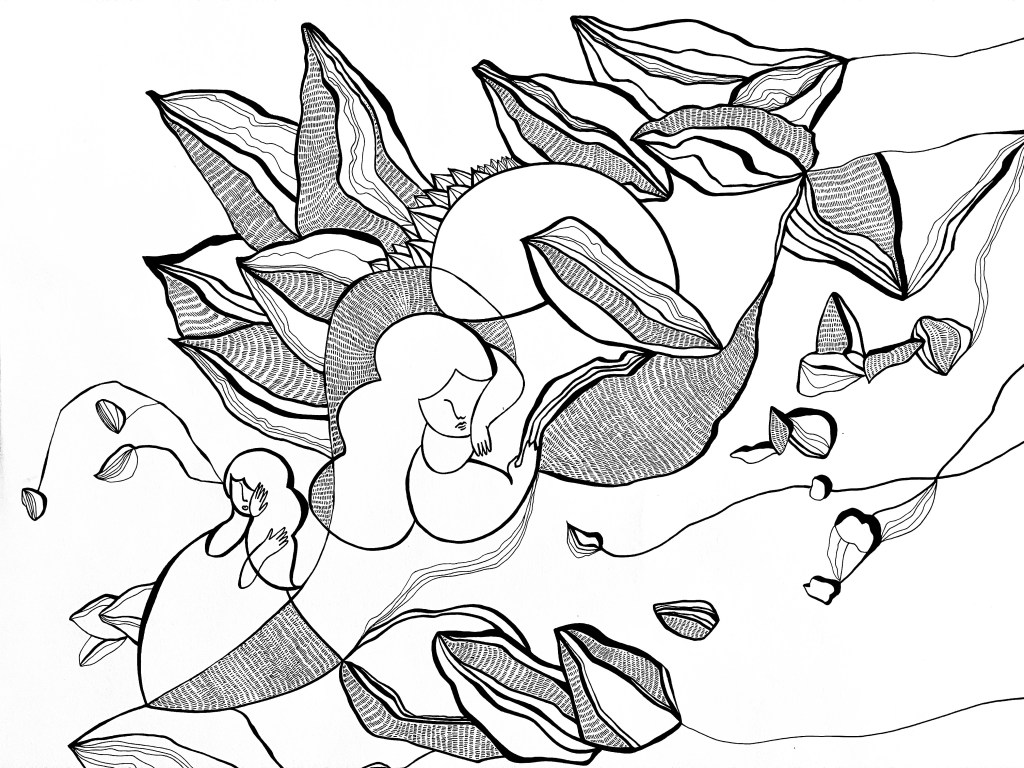
Responding to these ideas, I drew this image. I was exploring the shapes, the lines, their weights; I embraced each element as it developed and did not have a conception of the final composition in my mind as I worked. Improvising is a practice that I am familiar with, both as an artist and a k-8 classroom teacher; however, even with my “lived realities” serving as a solid foundation for all things I touch or conceive, I still felt a sense of precariousness as I worked: how was I supposed to know how many lines make my picture “done?” How do I resolve the balance between negative and positive space? How do I know when color should be added, if at all? My process was left intentionally ambiguous: the answers to all my queries were not abundantly clear but seemed to arrive organically, as each mark built off another.
While drawing, I deliberated: am I researching as I make this? Are my thoughts data? Or is the object itself data? In this case, are data simply an amalgam of thoughts coupled with motions that sometimes produce other things like marks? What happens if I think even less when I draw? Can I even quantify how many thoughts go into a process, or curb my electrons from firing?
Additionally, how do I compile any of this and explain it to a principal, a parent, or a 5-year-old? How do I verify anything was actually thought? Can I really identify if an improvised line looks different than an intentional one? What rubric exists for that? And how do I react to the aesthetic judgments that I receive from my audience? Will that data inform my future choices… research? Overall, I struggle to delineate where knowledge begins and ends; I am uncomfortable with the compartmentalization of existence, yet I understand that constraints are beneficial tools in navigating the void.
I am constantly wondering how much precision can even be applied to any of these things. It seems like the answer could be: “enough to start thinking about something.”
Woo (2008) contends that “We need to take pains to make our subject comprehensible under the norms of the community that we wish to communicate with, then work to introduce the new, unfamiliar, or subversive” (p. 326), and this is what I strive to do, personally and professionally. I find that “researching” comes more naturally to myself and my students when there is time and space for ambiguity, that “data” could be a myriad of things, none of which are precise.
Sources:
Eisner, E. (1997). The Promise and Perils of Alternative Forms of Data Representation. Educational Researcher, 26(6), 4-10.
Lawrence-Lightfoot, S., & Hoffman Davis J. (1997). The Art and Science of Portraiture. Wiley.
Woo, Y. Y. J. (2008). Engaging New Audiences: Translating Research Into Popular Media. Educational Researcher, 37(6), 321–329.
 Vanessa Hoff