Two-Point Perspective:
Rendering Lived Realities
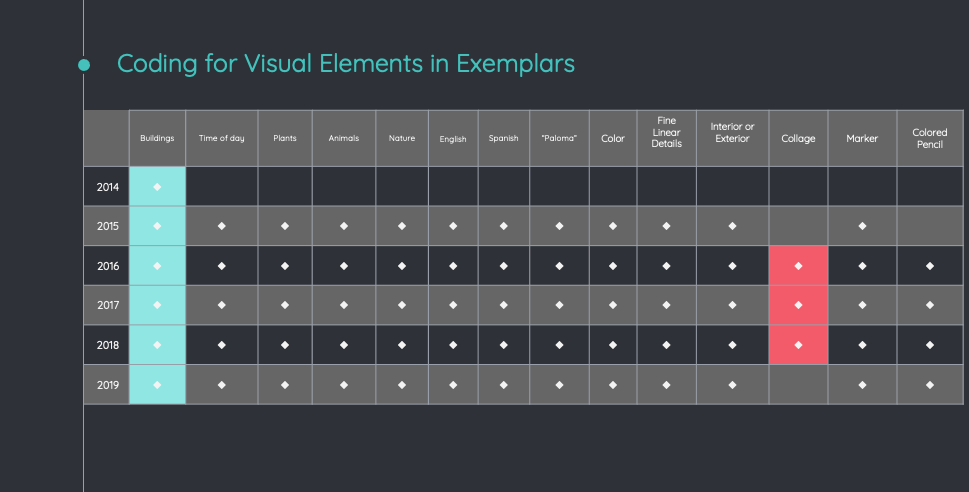
I examined two-point perspective exemplars completed from 2014-2019 to map the progression of my changing identity and teaching practices.
Informed by their content, I then created a series of large-scale ink drawings to represent personal history, feelings, and nods to my future practice and continuing evolution as an artist, researcher, and teacher.
This work addresses creative oppression, capital, agency, and the public/private dichotomy. This work is autoethnographic and manifests visually.
My renderings are created to raise public awareness of the lived realities of teachers; they are presented to stimulate reflection in both academic and artistic communities.
(part one: exemplars)
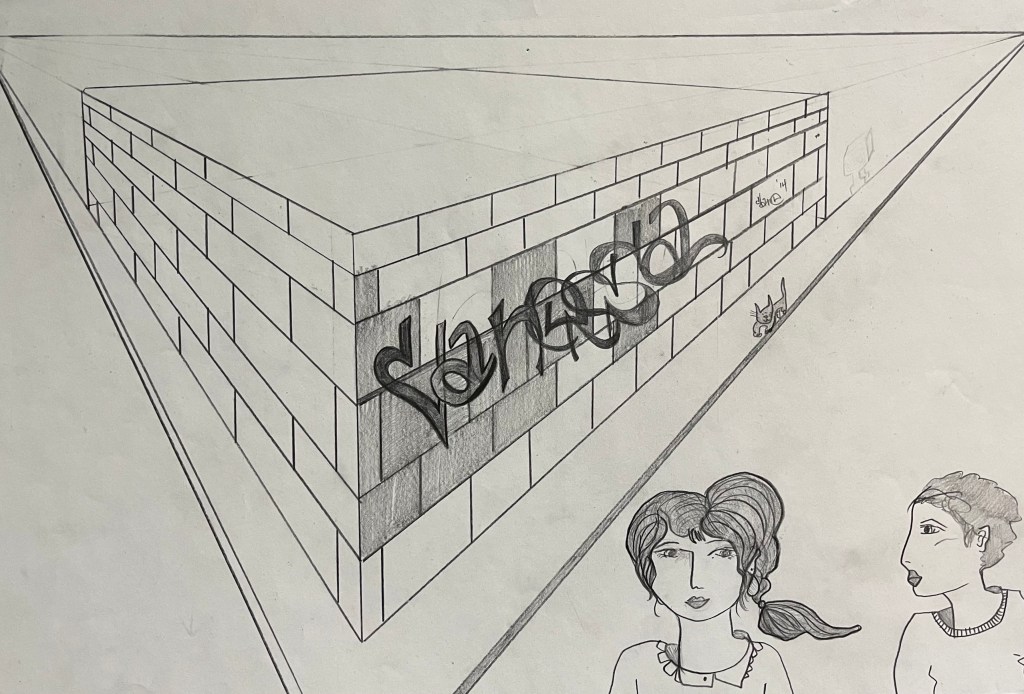
exemplar 1
12″ x 18″ (2014)
The earliest work exhibits almost no creative agency: mandated “learning objectives” took precedence over individual voice, expression, or identity. Both my exemplar and teaching (at this point), were heavily influenced by the authoritarian and test-driven school culture I found myself in. This was further compounded by my lack of tenure and my struggles to manage teaching 1,100 students a week. The constraints of operating in such a community are clearly evident in the visual content, or lack thereof.
This work is the bare-bones-unimaginative-box-checking-kind-of-art that I have now come to wholeheartedly reject.
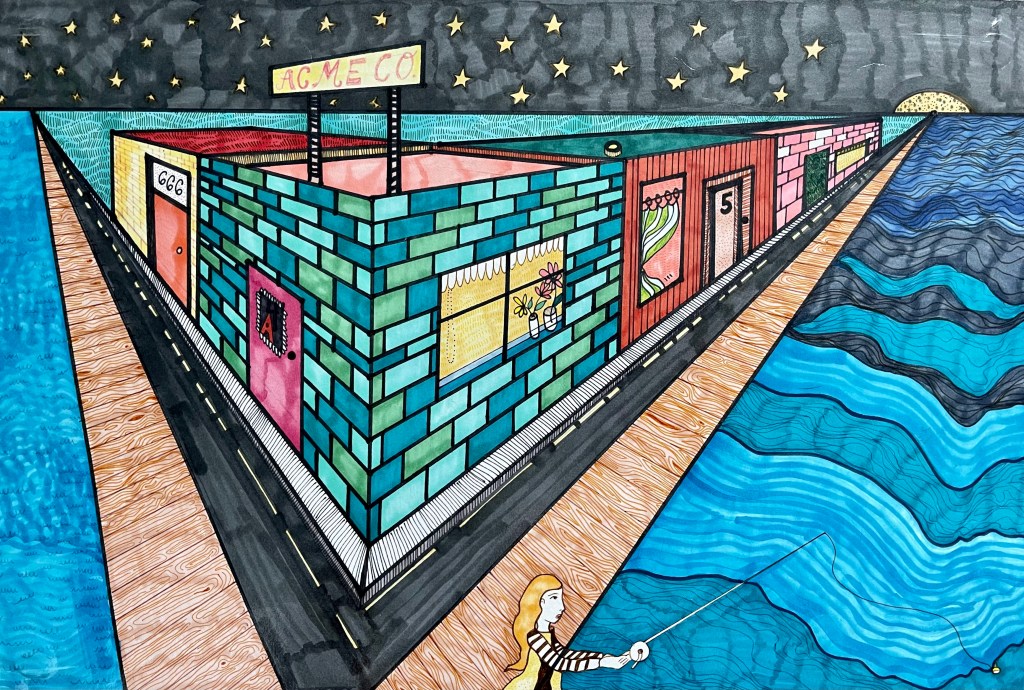
exemplar 2
12″ x 18″ (2015)
This work introduces color, time-of-day, multiple buildings, textures, elements of nature, and windows that invite the viewer to differentiate between “interior” and “exterior” spaces.
This work also shows material/content exploration: I am starting to layer fine-linear details (cross-hatching, stippling, woodgrain), over broad areas of foundational color. Moreover, the figure drawn in the foreground is flinging the most delicate fishing line into an abstracted seascape: this is my first attempt at suggesting a sense of movement against a static background.
The water and the ideas of “fishing” were on my mind because my experiences teaching made me feel like I was drowning; I felt that I needed to seek other environments.
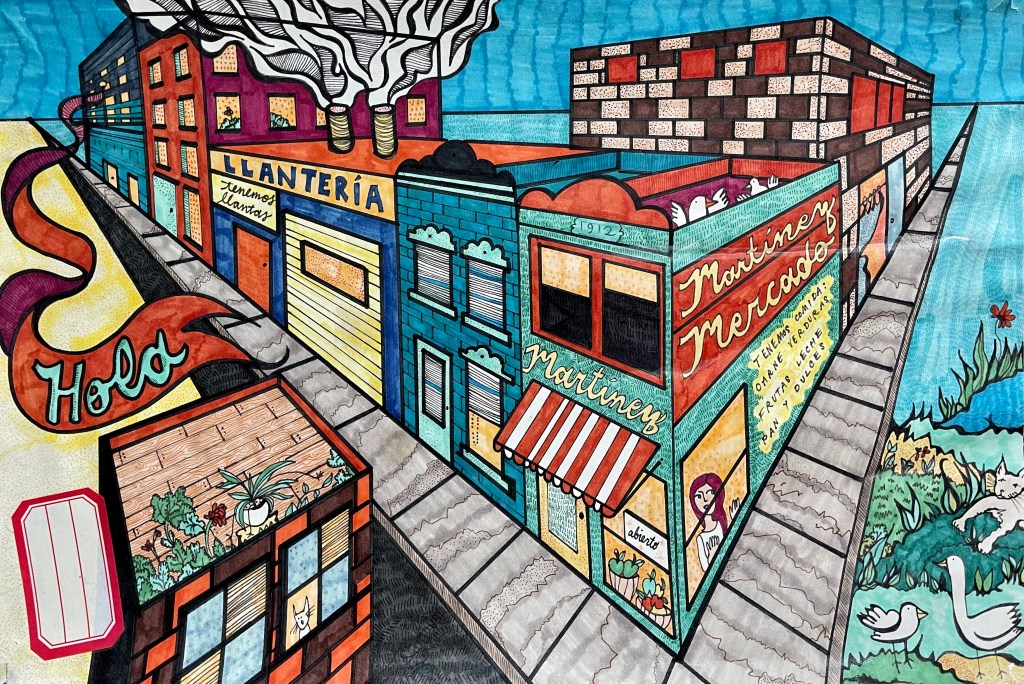
exemplar 3
12″ x 18″ (2015)
First introduction of a building in the foreground.
First examples of buildings that pass the horizon.
First appearance of other animal life.
First introduction of pollution.
Use of text moves beyond generic store name or address; first introduction of Spanish language.
More exploration of gestural lines (movement), via flag.
Collaged a red/white sticker over a mistake and left it as a random shape, baffling many of my students. “What’s under there?” they kept asking. The more they asked, the more I wondered… “what is UNDER THERE? What is hiding underneath my cover-ups, my presented-self?“
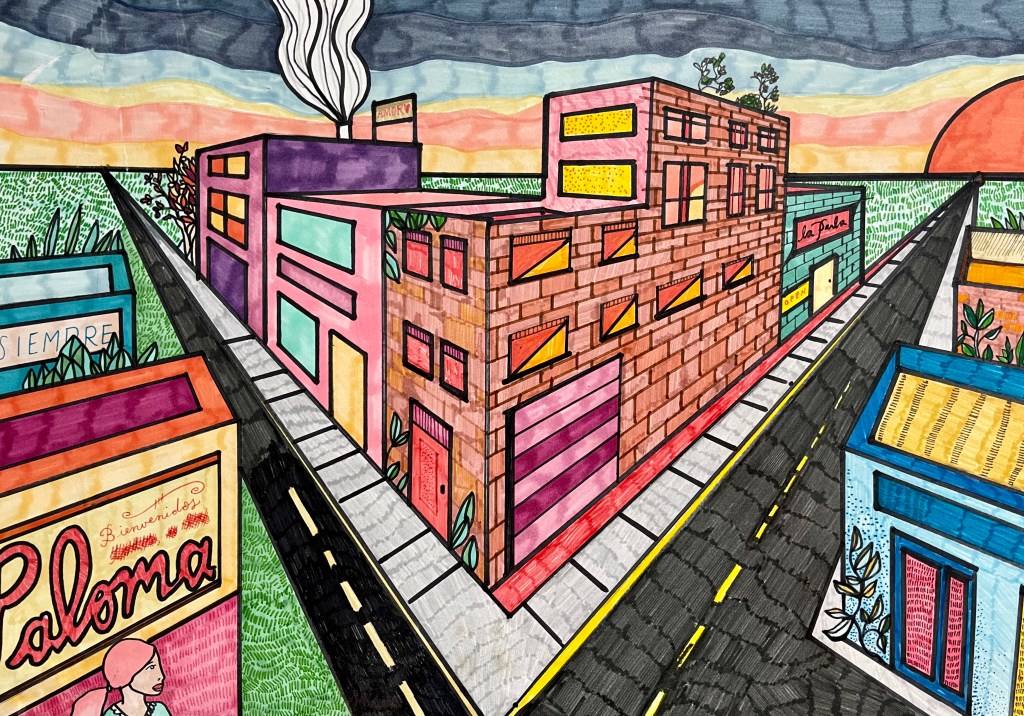
exemplar 4
12″ x 18″ (2015)
First appearance of the word: “Paloma.” This means “dove” in Spanish. In many cultures, doves are common symbols associated with love and peace.
I started writing this word in response to a sense of entrapment: as I grew more miserable in my position (continually stifled by oppressive educational policies and procedures), I found that visualizing myself as a bird was helpful. I imagined that I would somehow overcome being a relegated “specialist,” that I would no longer be “siloed” and rejected over “core academics” and “quantitative data.” Rather than embody the pain of being a demoralized teacher, I became (a) Paloma.
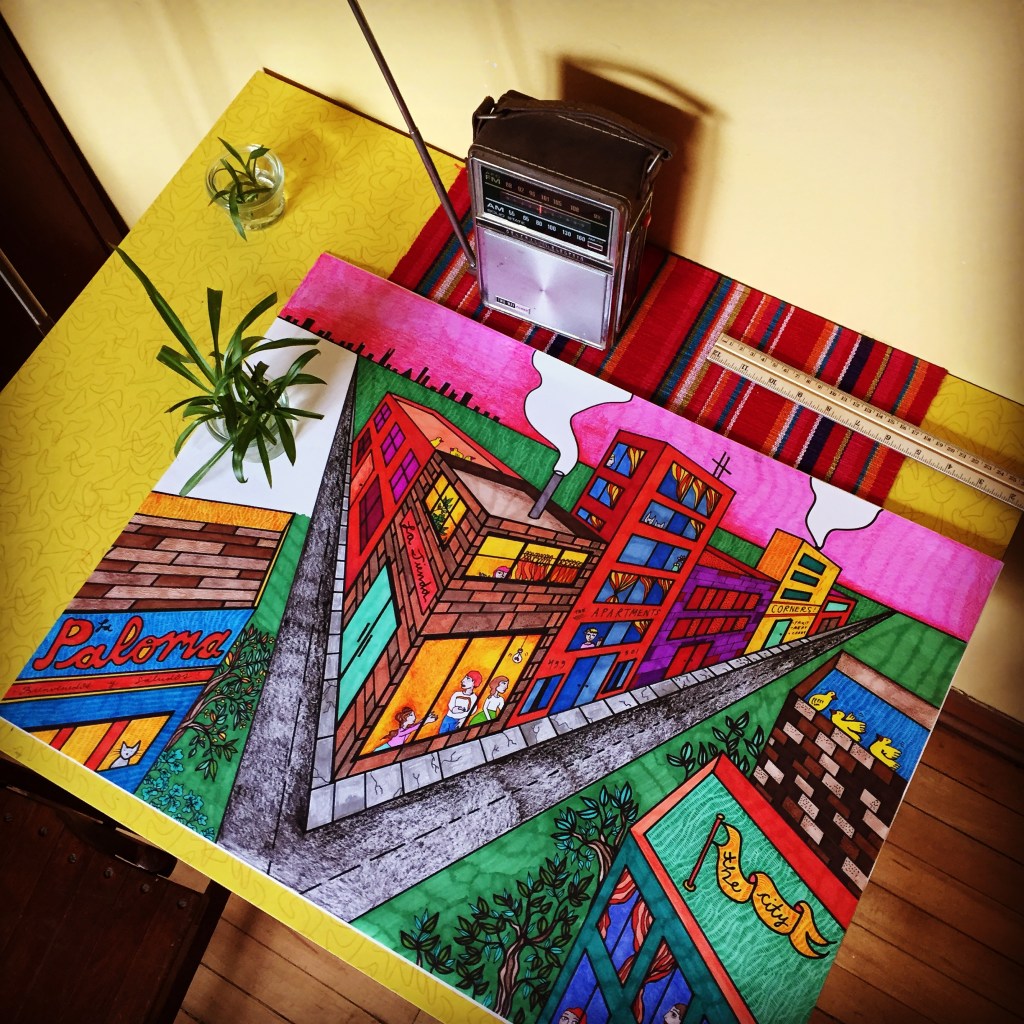
exemplar 5
18″ x 24″ (2016)
First increase in scale.
First introduction of colored pencils.
First birds drawn on rooftops.
First antenna.
First skyline.
Pollution portrayed with more opaque shape, indicative of experimenting with breaking up space in the picture plane.
English and Spanish language.
More interior space: intentional suggestion of narrative.
“I’m finally tenured. I endured the five year requirement. Now the district changed it to three, to entice more teachers to stay. I feel like a sucker.”
“I’m pregnant. I start drawing families. They’re awkward, like me.”
“I am so sick all the time; I learned how to low-key vomit into a garbage can, half my body standing in the art room, the other half making a mess in the hall. There is no one to give me a bathroom break. My admin can’t find a long-term sub to come to our neighborhood. I am anxious all the time.“
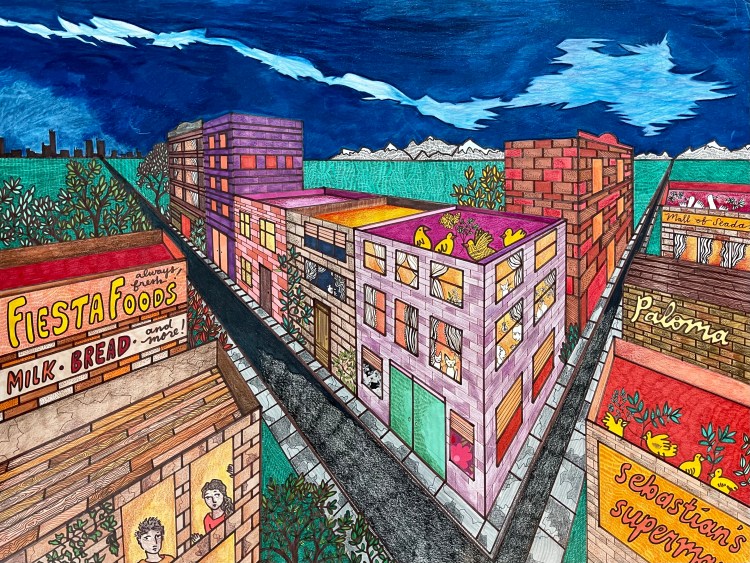
exemplar 6
18″ x 24″ (2016 – 2019)
First mountain range.
First intentional collaged-elements.
First intentional references to the architecture of the Pilsen and Englewood neighborhoods of Chicago.
In 2016, a little kindergartner was having a meltdown next door in the music room; I invited him to my space and asked if he wanted to collaborate: “do you want to draw with me?”
In a frenzy, he drew the erratic cloud that races across the sky. Such energy and vigor, he scrawled and raged, then said he felt better and left.
Creating connections, even through pain, is becoming more natural to me.
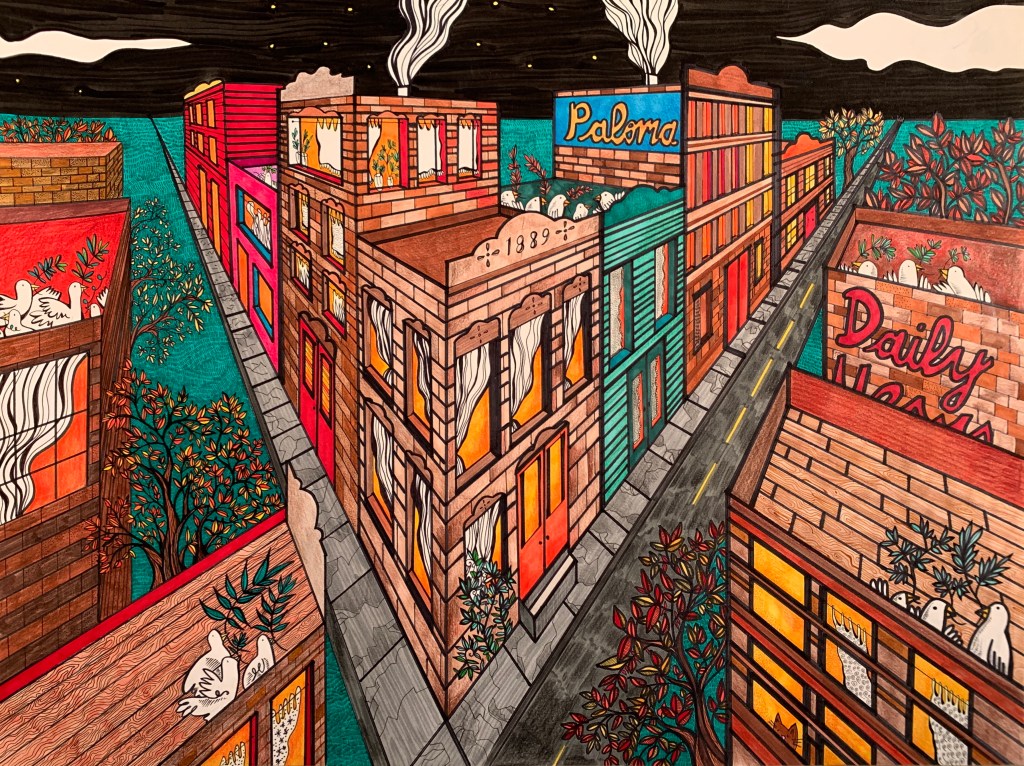
exemplar 7
18″ x 24″ (2016 – 2017)
First stoop.
No humans.
Continued exploration of texture, color, and space.
This remains one of my favorite exemplars; I especially enjoyed writing “Daily News,” as it was inspired by an actual “ghost sign” close to my home in Chicago’s Bridgeport neighborhood. Sitting on stoops, too, was an integral part of much of my Chicago experience.
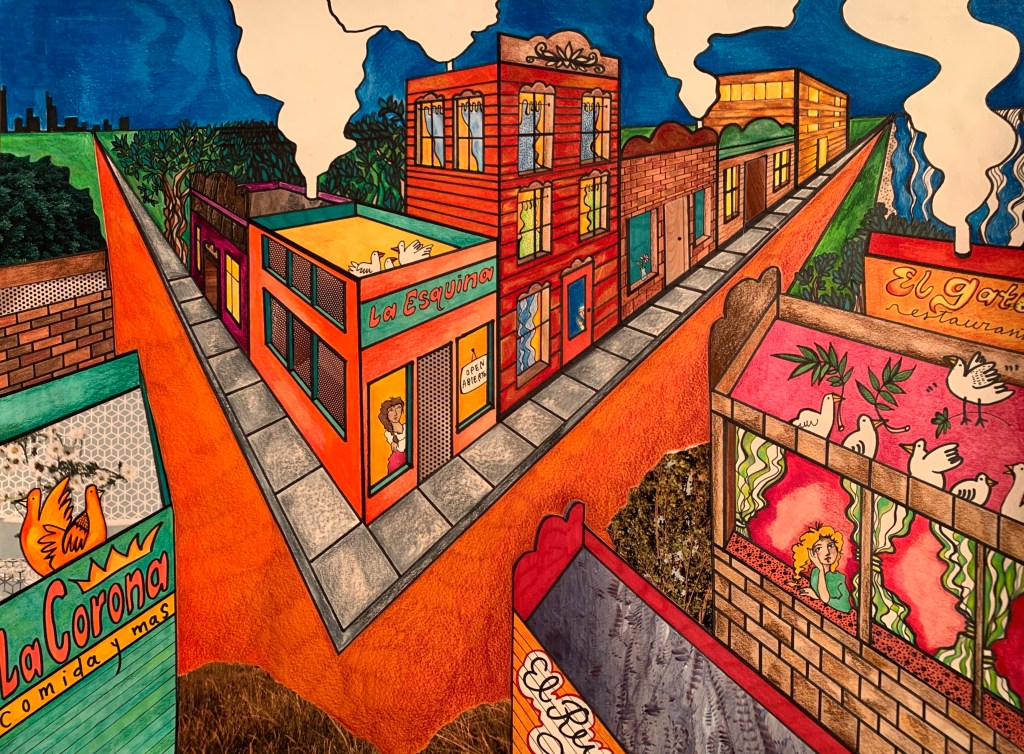
exemplar 8
18″ x 24″ (2017 – 2018)
Continued exploration of collaged elements.
“Paloma” is missing.
People are upset.
Uneasy.
“The sign in the store says open, but her face says closed.”
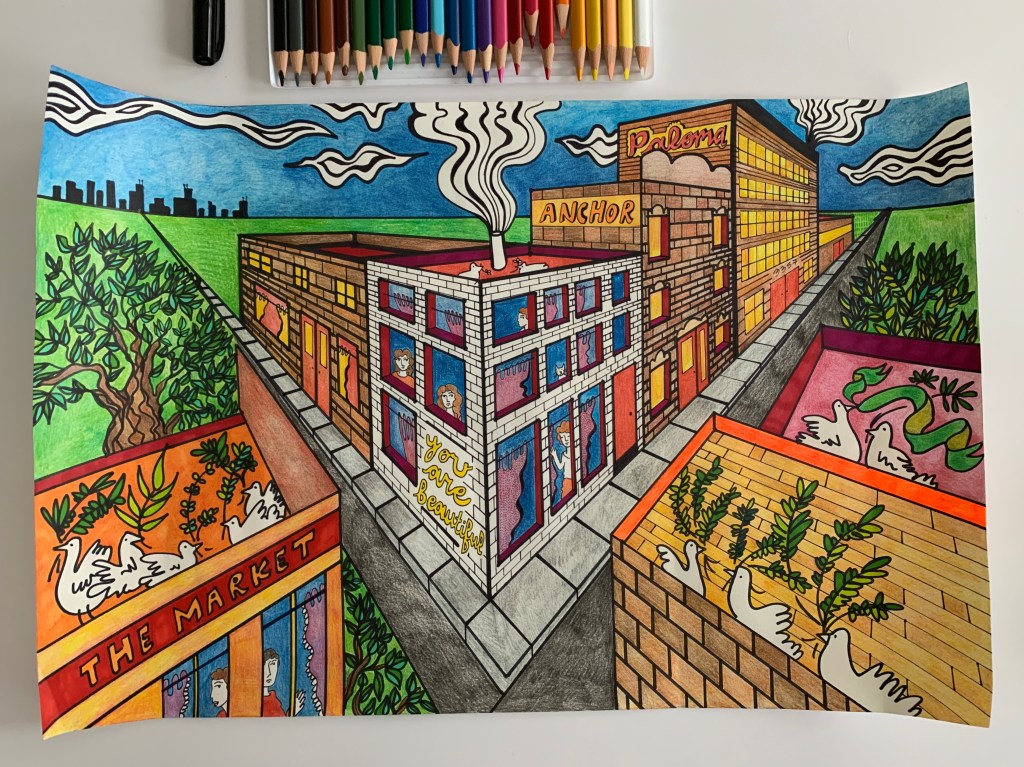
exemplar 9
12″ x 18″ (2019)
First positive message intentionally included:
you are beautiful.
“The new world I see and feel is brighter.”
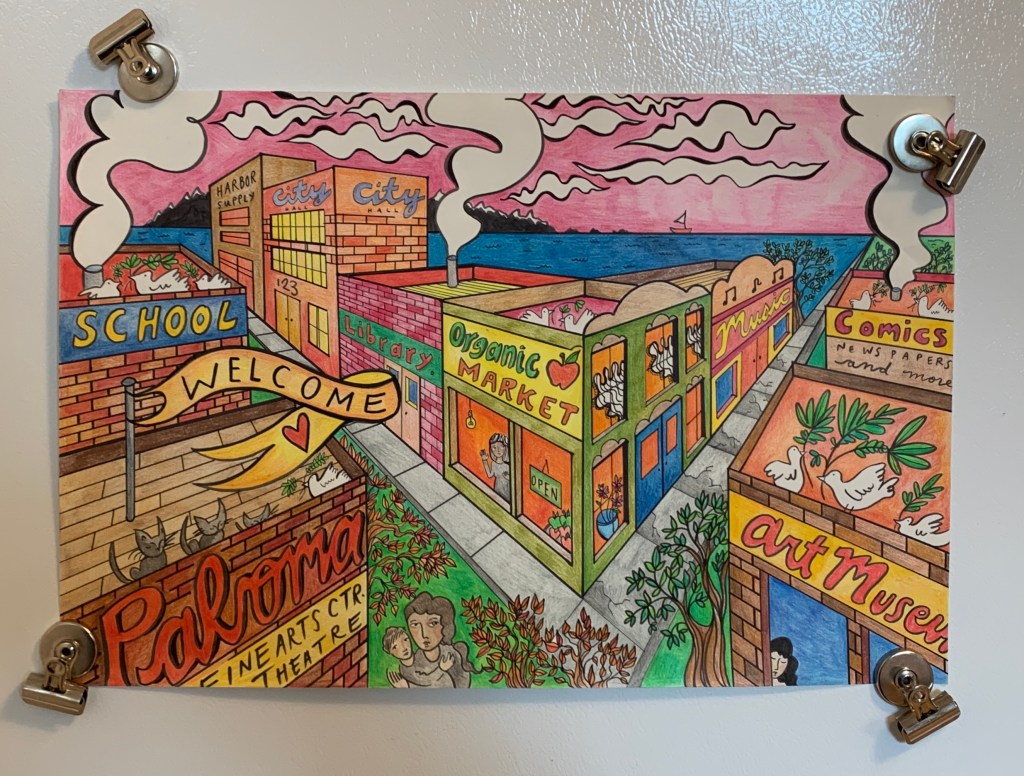
exemplar 10
12″ x 18″ (2019)
First intentional inclusion of businesses, organizations, and community centers that would be found in an “ideal neighborhood.”
First sailboat.
First ocean (in the entire background).
First island.
First portrayal of my son and I.
First person with closed eyes.
First heart symbol.
First music symbol.
(part two: renderings)
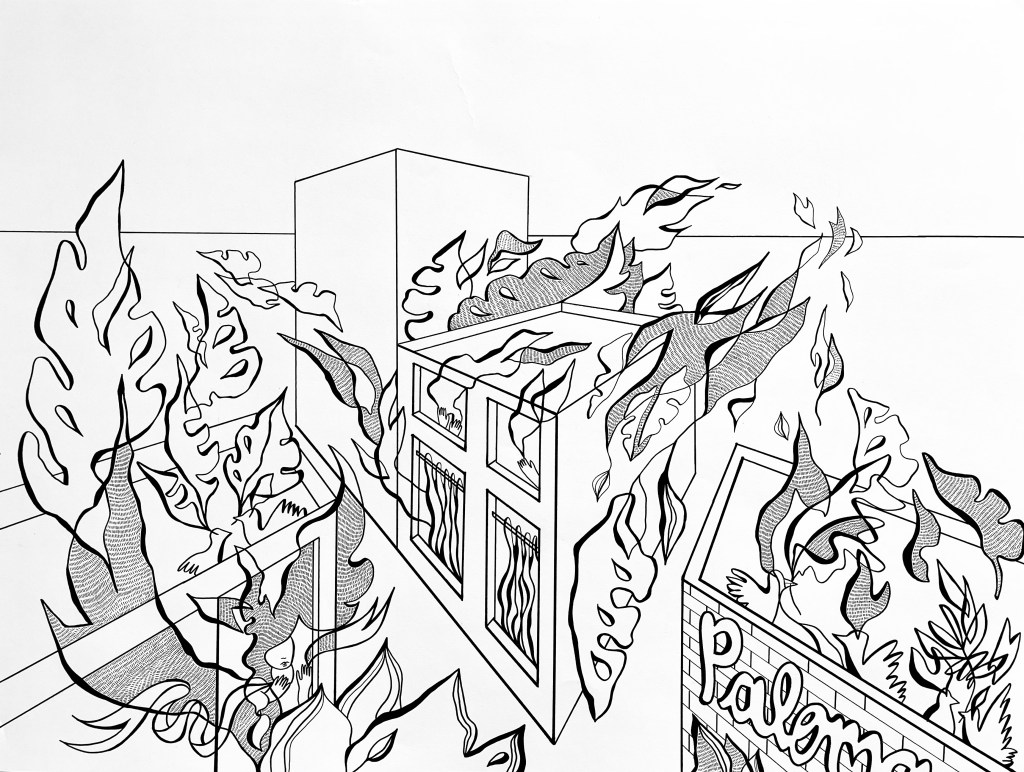
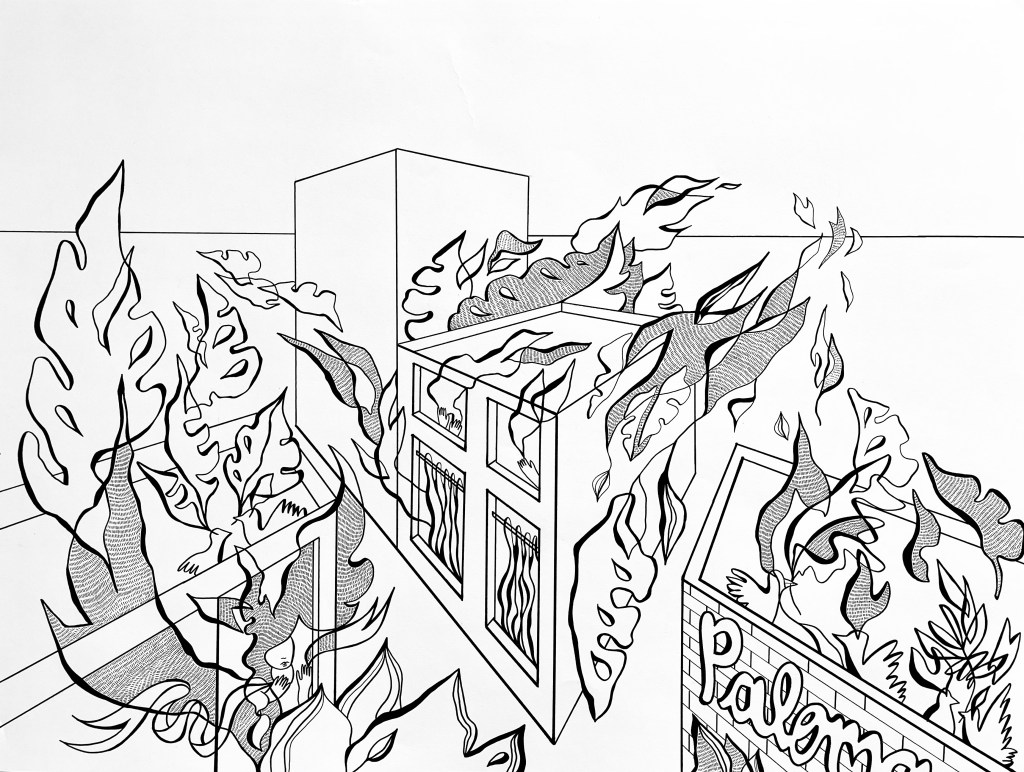
My first rendering was done in complete disregard to any previous constraint. I unified abstract shapes with representational images to arrive at a new aesthetic juxtaposition. I embraced the ambiguity of the shapes: are they fire? Are they leaves? It seemed appropriate to visually and conceptually navigate this, as that process is very similar to how I feel teaching remotely during a pandemic.
“Is it consuming me, or am I growing?”

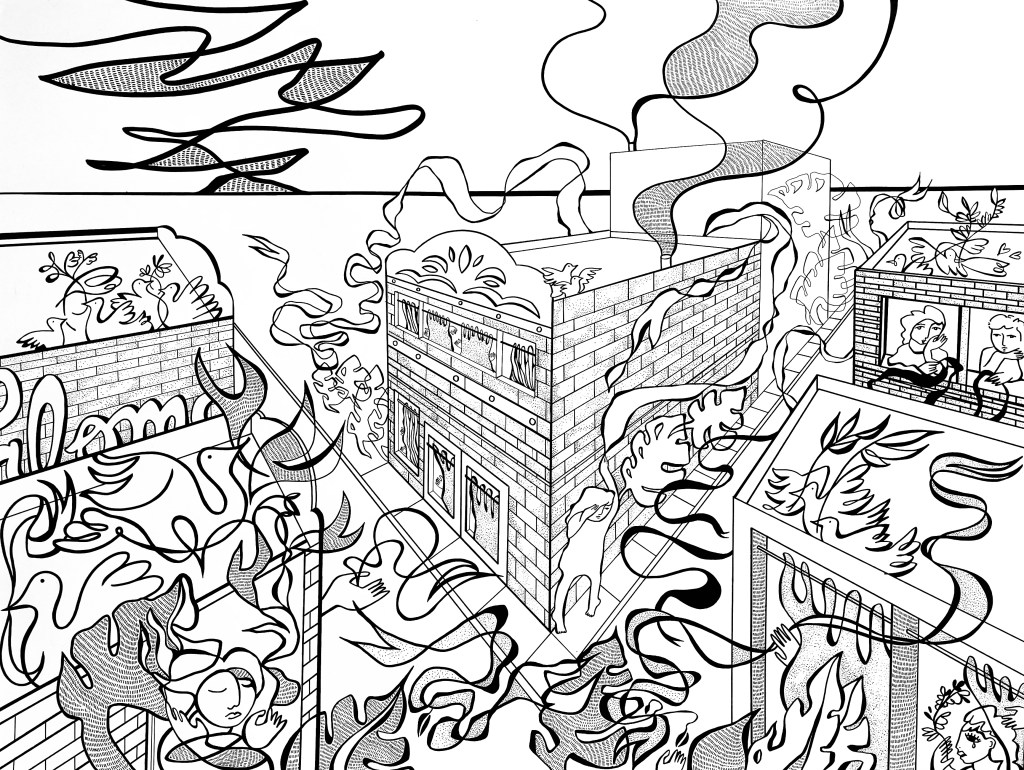
My second rendering paid particular attention to movement, line, and balance. I also found emotional release in the mark-making: I used the compulsive stippling and hatching to field my anxiety as I continue to teach, and watch the contemporary world burn in politics, plots, and pain.

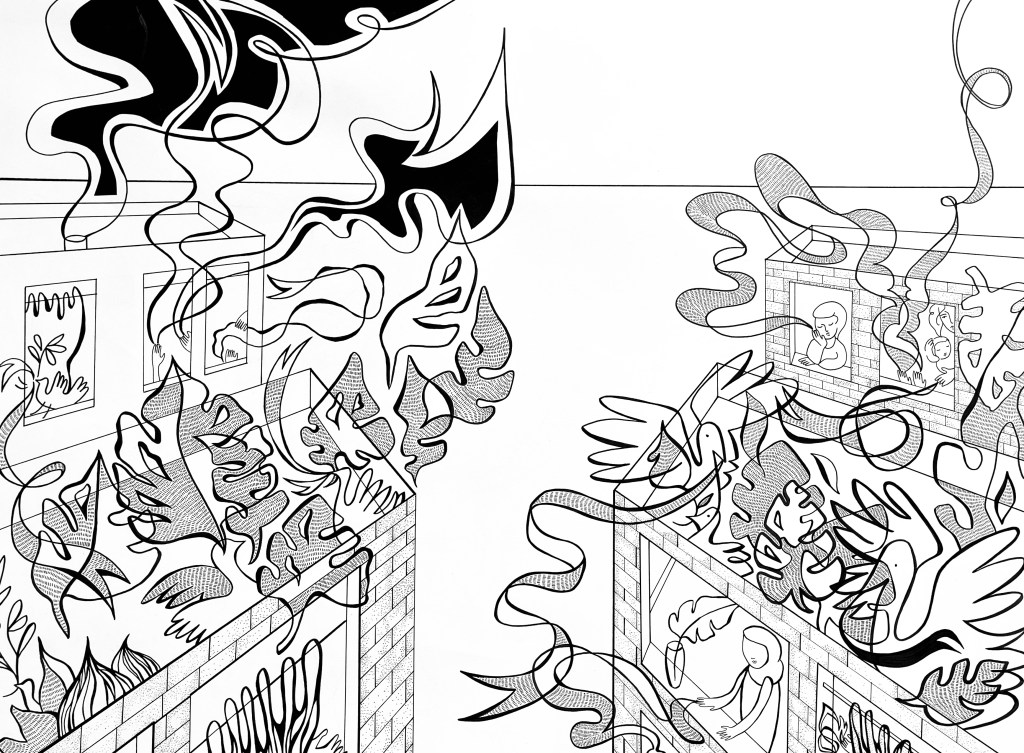
My third rendering intentionally leaves out the central buildings present in all previous drawings; this creates a new visual dynamic. I am still not sure if I enjoy the “duality” suggested by this compositional choice… but the empty field is suggestive of an unwritten future.
“What will become of this?”
gallery
 Vanessa Hoff